
Do Google Updates Actually Change SEO Tactics?
Google updates indeed change SEO tactics, significantly impacting website visibility and ranking strategies. These updates, such as Penguin and Panda, have shifted the focus towards high-quality, relevant content and away from outdated practices like keyword stuffing. Websites must now focus on mobile optimization and enhancing user experience. This is required due to mobile-first indexing. Also voice search is becoming popular. So websites need to adjust their keyword usage to match how people speak when making voice queries. Backlink diversity and content relevance are continuously reevaluated to align with updated algorithms. Marketers need to change with the times. They should learn from new developments and keep up with current strategies and industry trends. This will help them stay ahead of the competition.
Key Takeaways
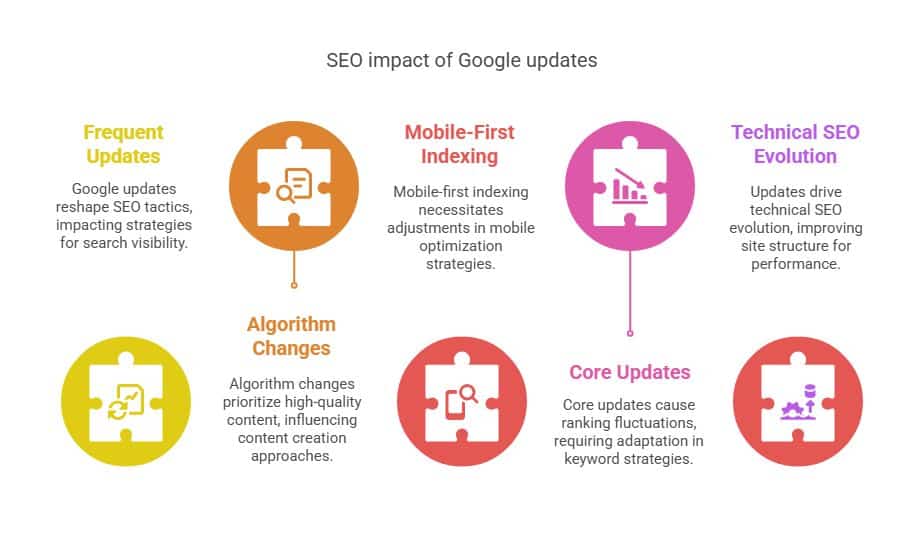
- Google updates frequently reshape SEO tactics, impacting strategies for maintaining search visibility and rankings.
- Algorithm changes prioritize high-quality, relevant content, influencing content creation and optimization approaches.
- Mobile-first indexing and user experience enhancements necessitate adjustments in mobile optimization strategies.
- Core updates cause ranking fluctuations, requiring ongoing adaptation in keyword and backlink strategies.
- Updates drive technical SEO evolution, improving site structure, speed, and user experience for better search performance.
Understanding Google’s Algorithm Updates
Understanding Google’s algorithm updates is crucial for anyone involved in digital marketing and SEO. These updates, often shrouded in a veil of complexity, directly impact website visibility and search rankings. While Google maintains some level of algorithm transparency, the vast web of ranking factors remains intricate and dynamic. Marketers and SEO professionals must constantly adapt to these changes to maintain or improve their site’s performance in search results.
One key aspect of Google’s algorithm updates is their impact on local search. Businesses that rely on local traffic must remain vigilant as updates can significantly influence local search rankings. This highlights the importance of understanding location-based signals and optimizing content accordingly. Whether through the enhancement of Google My Business listings or the refinement of local keywords, staying attuned to these changes is essential for local visibility.
The update frequency of Google’s algorithms further complicates the landscape. With updates occurring frequently—sometimes several times a year—staying current requires continuous learning and adaptation.
Google’s use of artificial intelligence in its algorithms adds another layer of complexity. AI-driven updates, such as BERT or RankBrain, prioritize understanding search intent and context, urging marketers to focus on creating high-quality, relevant content.
Historical Impact on SEO Practices

Over the years, Google’s algorithm updates have consistently shaped and reshaped SEO practices, compelling marketers to adapt their strategies to maintain search visibility. These updates have influenced a broad spectrum of SEO tactics, ranging from local SEO enhancements to the increasing emphasis on social signals. Each update not only addresses existing search issues but also anticipates evolving digital trends, thereby influencing the way marketers approach SEO.
The historical impact of Google’s updates can be demonstrated through various changes in SEO practices:
| Update Type | Affected Practice | Resulting Focus |
| Local Updates | Local SEO | Enhanced local targeting |
| Penguin/Panda | Content Quality | Focus on high-quality content |
| Hummingbird/RankBrain | Technical SEO | Emphasis on semantic search and user intent |
Local SEO, for instance, has seen significant transformation, with updates prioritizing local search results, thus pushing businesses to optimize their local presence more diligently. Similarly, social signals have gained importance as indicators of content relevance and authority, influencing SEO strategies to integrate social media more effectively.
Moreover, the rise of video content and image optimization is a testament to Google’s recognition of multimedia’s role in user engagement. Marketers are now investing in high-quality visual content to improve search rankings, understanding that image optimization can enhance user experience and site load times.
Technical SEO has also been refined through updates, focusing on site structure and user experience to ensure seamless navigation. This evolution reflects Google’s commitment to elevating user satisfaction, ensuring that search results are not only relevant but also accessible.
Through these historical shifts, SEO has become a dynamic field, continuously adapting to Google’s updates, which serve as both a challenge and a catalyst for innovation in digital marketing strategies.
Core Updates and Their Significance

Amidst the ever-evolving landscape of search engine optimization, Google’s core updates hold significant sway over SEO strategies. These updates, occurring with unpredictable core update frequency, bring about notable shifts in algorithm change patterns, leaving webmasters and SEO professionals in a perpetual state of adaptation.
Unlike minor updates, core updates are comprehensive in scope, affecting a wide array of ranking factors and causing substantial ranking fluctuations across various websites. Understanding the intricacies of these changes is crucial for SEO practitioners aiming to maintain or improve their site’s visibility.
Google does not typically disclose the specific alterations made during core updates, adding a layer of complexity to deciphering their impact. As a result, sites may experience sudden drops or gains in rankings, prompting a need for swift analysis and strategic adjustments.
The implications of core updates extend beyond mere ranking shifts, with potential penalty implications for sites that fail to align with Google’s evolving standards. This can result in significant traffic and revenue losses, underscoring the necessity for proactive measures.
However, not all sites negatively impacted by a core update have necessarily committed SEO malpractice; rather, the updates may simply reflect changes in Google’s understanding of search intent and content relevance.
Recovery strategies following a core update often involve a thorough review of website content, user experience, and technical SEO elements. Emphasizing quality, relevance, and user satisfaction remains paramount.
Regularly monitoring algorithm change patterns and engaging in continuous learning enables SEO professionals to develop effective strategies that align with Google’s dynamic criteria, thereby minimizing the adverse effects of ranking fluctuations and optimizing for recovery.
The Role of Content Quality

In the dynamic realm of search engine optimization, content quality stands as a cornerstone for achieving sustained visibility and ranking success on Google. The emphasis on content relevance, keyword density, and writing style forms the foundation of an effective SEO strategy. As Google continues to refine its algorithms, the importance of creating high-quality content that resonates with the target audience cannot be overstated.
Content quality encompasses several critical elements that drive audience engagement and improve search engine rankings. These elements include relevance to the audience’s needs, strategic keyword density to optimize discoverability, and a writing style that ensures clarity and readability. Moreover, the integration of multimedia—such as images, videos, and infographics—enhances the user experience, keeping visitors engaged longer and reducing bounce rates.
Consider the following table, which outlines key factors contributing to content quality:
| Element | Description | Impact on SEO |
| Content Relevance | Ensures information meets the audience’s needs | Boosts engagement and lowers bounce rate |
| Keyword Density | Optimal keyword use without overstuffing | Improves discoverability and ranking |
| Multimedia Integration | Use of images, videos, and infographics to enrich content | Enhances user experience and engagement |
Incorporating these elements effectively requires a meticulous approach to content creation. Prioritizing quality over quantity ensures that content remains valuable over time, adapting seamlessly to algorithm updates. The synergy between content relevance, keyword density, and multimedia integration fosters a compelling narrative, encouraging audience engagement and establishing authority in the digital space. As SEO continues to evolve, crafting content that aligns with these principles is paramount for sustained success.
Mobile-First Indexing Influence
Mobile-first indexing has fundamentally reshaped the landscape of SEO, emphasizing the necessity for websites to prioritize mobile optimization to maintain and improve their search rankings. As Google now predominantly uses the mobile version of content for indexing and ranking, understanding mobile optimization techniques becomes imperative for businesses seeking to enhance their digital presence.
One critical aspect is the responsive design importance. Websites that adapt seamlessly to different screen sizes ensure a consistent user experience, which is essential given the increasing reliance on mobile devices. A responsive design not only aligns with Google’s mobile-first approach but also meets the expectations of today’s mobile-savvy consumers.
Site speed factors play a significant role in mobile-first indexing. Mobile users often encounter various connectivity issues, and as a result, a site’s loading speed can make or break the user experience. Optimizing images, leveraging browser caching, and minimizing redirects are strategies that can enhance site speed, thereby positively influencing search rankings.
Furthermore, understanding mobile user behavior is crucial. Mobile users tend to have different browsing patterns and preferences compared to desktop users. Tailoring content and navigation to suit these behaviors can lead to higher engagement rates and better conversion outcomes.
Lastly, app indexing strategies have emerged as a vital component of mobile-first indexing. By allowing apps to be indexed by search engines, businesses can drive traffic directly to their applications, enhancing visibility and user engagement. Implementing app indexing ensures that content within apps can be discovered directly from search results, bridging the gap between web and app experiences.
Backlinks and Update Effects

Backlinks hold substantial importance in SEO strategies, serving as a testament to a site’s authority and relevance. As Google continues to refine its algorithms, the effects on backlinks become increasingly significant. Changes in Google’s updates often necessitate a reassessment of backlink diversity and link building strategies, ensuring they align with the latest standards for quality and relevance.
To navigate these evolving landscapes effectively, consider the following aspects:
- Backlink Diversity: A diverse backlink profile is crucial. Relying on a single type of backlink or source can make a site vulnerable to algorithm changes. Incorporating a variety of high-quality backlinks from different domains enhances credibility and reduces risk.
- Anchor Text Optimization: The text used in backlinks plays a pivotal role. Over-optimized or irrelevant anchor text can be flagged by updates, impacting rankings negatively. Striking the right balance in anchor text is essential for maintaining SEO health.
- Competitor Analysis: Regularly analyzing competitors’ backlink profiles can provide insights into effective strategies and potential gaps. Understanding how competitors adapt to updates can inform your own link building strategies and help stay ahead in the competitive landscape.
- Identification of Toxic Backlinks: Algorithm updates often include improved methods for identifying and penalizing toxic backlinks. Regularly auditing your backlink profile helps identify and disavow harmful links, protecting the site from potential penalties.
User Experience and SEO Changes

The evolution of Google’s algorithm has consistently underscored the importance of user experience in shaping SEO strategies. As search engines become increasingly sophisticated, they prioritize websites that cater to user behavior shifts, ensuring content is not only relevant but also easily accessible and engaging. This emphasis has led to significant changes in how digital marketers approach SEO, with a focus on refining design aesthetics, enhancing interactivity, and adhering to stringent accessibility standards.
Design aesthetics play a crucial role in user engagement. A visually pleasing and intuitive layout can significantly impact a user’s time on site, reducing bounce rates and increasing conversions. As such, web designers and SEO specialists are encouraged to work closely to create designs that are both attractive and functional, aligning with Google’s evolving criteria.
Moreover, accessibility standards have become a pivotal aspect of SEO strategies. Ensuring that websites are accessible to all users, including those with disabilities, not only broadens the audience reach but also aligns with Google’s commitment to inclusivity. This involves optimizing site navigation, utilizing alt text for images, and ensuring that interactive elements, such as forms and buttons, are operable by all users.
Page speed also remains a critical factor in user experience, directly influencing SEO rankings. Slow-loading pages can deter users, prompting them to abandon sites in favor of faster alternatives. Consequently, optimizing page speed through efficient coding, image compression, and server enhancements is paramount.
Voice Search Optimization Trends

With the surge in popularity of smart speakers and voice-activated assistants, voice search optimization has emerged as a pivotal trend in modern SEO strategies. The rise of devices such as Amazon Alexa and Google Home has shifted the way users perform searches, prompting SEO professionals to adjust their tactics.
Voice search optimization requires a nuanced understanding of how users interact with technology through spoken language.
Here are four key trends shaping voice search optimization:
- Voice Search Keywords: Unlike traditional text-based searches, voice search queries are often longer and more conversational. Identifying and incorporating these voice search keywords into content can significantly enhance visibility.
- Conversational Queries: As users become more comfortable with speaking to their devices, the nature of queries evolves. Optimizing for conversational queries means creating content that answers questions succinctly and directly, aligning with natural speech patterns.
- Local Search Optimization: Voice searches frequently have a local intent, with users seeking nearby services or information. Ensuring that content is optimized for local search terms can lead to increased traffic and engagement from voice-activated searches.
- Smart Speaker Integration: Businesses leveraging smart speaker integration can provide seamless experiences to users. This involves ensuring that their digital presence is compatible with smart speakers, enabling users to access information effortlessly.
Additionally, the role of voice search analytics cannot be overstated. Analyzing data from voice searches helps in understanding user behavior, preferences, and trends, allowing for more targeted and effective SEO strategies.
Embracing these trends will be crucial for businesses aiming to stay relevant in an increasingly voice-driven digital landscape.
Evolving Keyword Strategies

Adapting to the dynamic landscape of search engine optimization necessitates a continual evolution of keyword strategies. As Google updates its algorithms, SEO professionals must refine their approaches to remain effective. A critical component of this evolution is the strategic use of long tail keywords. These keywords, composed of three or more words, cater to specific queries and capture targeted traffic that often converts at a higher rate due to the precision of user intent.
Understanding keyword intent has become paramount in this evolving landscape. It involves deciphering the purpose behind a user’s search query, whether informational, navigational, or transactional. Aligning content with the correct intent not only enhances user experience but also improves search engine rankings. This shift underscores the importance of semantic search, where the context of words in a search query is analyzed to deliver more relevant results.
Niche targeting is another strategy gaining traction. By focusing on specialized areas within broader markets, businesses can cater to specific audience needs, reducing competition and enhancing engagement. Coupling niche targeting with long tail keywords allows for content that resonates deeply with searchers’ interests.
Keyword clustering is an innovative approach that groups related keywords to optimize for multiple search terms within a single piece of content. This method not only broadens the scope of search visibility but also supports semantic search by addressing various facets of a topic.
Future-Proofing Your SEO Approach

In the ever-evolving realm of search engine optimization, future-proofing your SEO approach is essential to maintain competitive advantage and long-term success. As Google continues to refine its algorithms, staying ahead requires a strategic focus on key elements that are likely to remain relevant.
Here are four crucial tactics to consider:
- Emphasize Technical SEO: Ensuring that your website is technically sound is foundational. This includes optimizing site speed, ensuring mobile-friendliness, and resolving crawl errors. A robust technical SEO framework not only enhances user experience but also makes your site more accessible to search engines.
- Leverage Local SEO: With the rise of mobile searches, local SEO has become increasingly important. Optimizing for local search involves refining your Google My Business profile, accumulating positive reviews, and ensuring consistent NAP (Name, Address, Phone Number) information across directories. This strategy helps businesses capture local audiences effectively.
- Incorporate Video Content: As video consumption surges, integrating video into your content strategy can significantly boost engagement. Platforms like YouTube, coupled with optimized video SEO practices, can drive traffic and enhance visibility. Video content not only attracts user attention but also increases time spent on your site.
- Utilize Schema Markup and Monitor Social Signals: Implementing schema markup helps search engines understand your content better, potentially leading to enhanced rich snippets in search results.
Additionally, while social signals are not direct ranking factors, they can amplify content reach and indirectly influence search visibility through increased traffic and engagement.
Final Thoughts
Google updates undeniably influence SEO tactics, prompting shifts in strategies to sustain visibility and rankings. From prioritizing high-quality content and adapting to mobile-first indexing, to leveraging voice search and refining backlink diversity, SEO must evolve in line with algorithmic changes.
Need help navigating Google’s evolving SEO landscape? Connect with Syville Gacutan, an SEO Specialist in the Philippines, for expert insights and tailored strategies. Syville can help your business adapt to algorithm changes, enhance search visibility, and achieve sustainable growth. Reach out today for personalized SEO solutions!