
10 Best Strategies for SEO After Google Updates
To excel in SEO after Google updates, prioritize creating high-quality content that addresses user needs and enhances engagement. Ensure your site provides an optimal user experience by improving navigation, speed, and mobile compatibility. Utilize organized data formats to enhance your website’s visibility in search engine results. Ensure your website loads quickly by employing methods such as compressing images and enabling browser caching. Leverage semantic and voice search by focusing on conversational queries. Frequently check Core Web Vitals by utilizing tools such as Google Search Console. Stay informed on algorithm changes through official channels and peer collaboration. By exploring these strategies, you can master the art of improved site rankings.
Key Takeaways
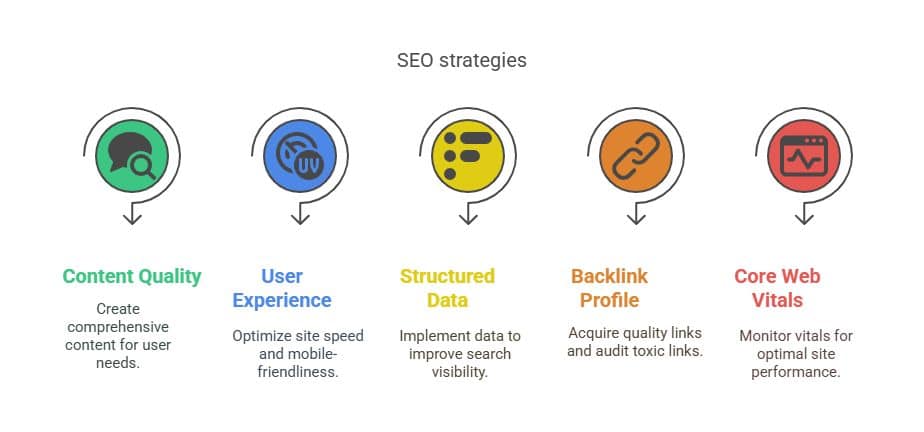
- Focus on creating high-quality, comprehensive content that aligns with user needs and Google’s algorithm updates.
- Enhance user experience by optimizing site speed, mobile-friendliness, and intuitive navigation.
- Implement structured data to improve visibility and click-through rates in search results.
- Strengthen backlink profile by acquiring high-quality links from authoritative websites and auditing for toxic links.
- Monitor Core Web Vitals regularly to ensure optimal loading speed, interactivity, and visual stability.
Focus on Quality Content

The text rewritten with a normal vocabulary, few commas, and a low degree of burstiness using only the English language, is as follows: Producing high-quality content is crucial for search engine optimization. This has become increasingly important due to Google’s regular algorithm changes. As search engines strive to deliver the most relevant and valuable information to users, quality content emerges as a pivotal ranking factor.
This emphasis compels businesses and content creators to rethink their content strategy, ensuring it aligns with the intricate mechanisms of search engine algorithms to improve rankings and attract organic traffic.
Crafting content that is not only informative but also engaging is essential. High-quality content should address the needs and queries of the audience, offering insights and solutions that potential readers seek. By doing so, it naturally garners more organic traffic, as users are more likely to engage with, share, and return to content that provides genuine value.
Furthermore, content that resonates with the audience can lead to increased dwell time and lower bounce rates, metrics that search engines consider when ranking pages.
A robust content strategy should also incorporate the principles of comprehensiveness and uniqueness. This means developing content that covers topics thoroughly, providing a fresh perspective or unique insights that differentiate it from competitors.
Frequently updating & improving content helps it stay relevant in the rapidly changing digital world. This can enhance its ability to rank well as a ranking factor.
Optimize for User Experience

Enhancing user experience has become a critical component of modern SEO strategies, especially in the wake of recent Google updates. These updates have increasingly prioritized user-centric approaches, making it essential for websites to optimize user experience to maintain or improve their search rankings.
A focus on user satisfaction not only aligns with Google’s evolving algorithms but also ensures a seamless and engaging interaction for visitors.
To effectively optimize user experience, consider the following:
- Improve Navigation: Ensure that your website navigation is intuitive and easy to follow. A well-structured menu and clear call-to-action buttons guide users through your site effortlessly, increasing the likelihood of engagement and conversion.
- Enhance Site Speed: Site speed is a crucial factor in retaining users. Slow-loading pages can lead to high bounce rates and diminished user satisfaction. Utilize tools like Google PageSpeed Insights to diagnose and address performance issues, ensuring your site loads quickly across all devices.
- Focus on Mobile-Friendliness: With a significant portion of web traffic originating from mobile devices, ensuring mobile-friendliness is imperative. A responsive design that adapts seamlessly to different screen sizes enhances the user experience and meets Google’s mobile-first indexing requirements.
- Adopt a User-Centric Design: Craft your website with the end-user in mind. This involves understanding user behavior and preferences, and designing interfaces that are both visually appealing and functional.
Regularly update your website based on user feedback to ensure it remains relevant and engaging.
Enhance Mobile Compatibility

As mobile devices continue to dominate the digital landscape, ensuring mobile compatibility has become a non-negotiable aspect of effective SEO strategies. With an increasing number of users accessing websites via smartphones and tablets, it is crucial to optimize your site for mobile usability to maintain or improve search rankings.
Google’s algorithm updates consistently emphasize the importance of a mobile-friendly experience, making it imperative for businesses to adapt accordingly.
The first step in enhancing mobile compatibility involves evaluating your site’s current performance on mobile devices. Tools like Google’s Mobile-Friendly Test can provide valuable insights into areas that require improvement.
A responsive design is paramount, allowing your website to adapt seamlessly to various screen sizes and resolutions. This not only enhances user experience but also positively influences search rankings.
Moreover, optimizing images and reducing page load times are essential elements in mobile usability. Large images and slow loading speeds can deter users and result in higher bounce rates.
Compressing images and utilizing browser caching are effective techniques for improving load times, ensuring users have a smooth and efficient experience.
Additionally, consider simplifying navigation and minimizing the use of pop-ups or interstitials that can disrupt the user experience on mobile devices. Intuitive, easy-to-use menus and clear calls-to-action will encourage user engagement and retention.
Ultimately, focusing on a mobile-friendly approach is not just about keeping up with search engine demands but also about meeting the expectations of users who increasingly rely on mobile devices for their online interactions.
Implement Structured Data

Structured data implementation is a powerful tool for improving a website’s visibility and click-through rate in search engine results. As search engine algorithms evolve, particularly with Google’s updates, the need to implement structured data becomes crucial in technical SEO.
Structured data helps search engines understand the content of a webpage, which can significantly impact search engine rankings through enhanced visibility such as rich snippets and other SERP features.
To effectively implement structured data, consider the following steps:
- Identify Content Types: Determine which content types on your website can benefit from structured data. Common examples include products, articles, events, and local business information.
- Choose the Right Vocabulary: Use standardized vocabularies like Schema.org to define elements on your webpage. This ensures that search engines can accurately comprehend the contents, enabling better optimization and more relevant search results.
- Validate Your Code: Utilize Google’s Structured Data Testing Tool or Rich Results Test to validate the structured data markup. This step ensures that your markup is error-free and adheres to Google’s guidelines, thus improving technical SEO efficiency.
- Monitor Performance: After implementing structured data, monitor the impact on search engine rankings and click-through rates. Tools like Google Search Console provide insights into how your pages are performing and whether the structured data is being picked up correctly by Google.
Prioritize Page Speed

Optimizing page speed is a critical component of effective SEO strategy, especially in the wake of recent Google updates. The importance of page speed has been underscored by Google’s algorithm updates, which increasingly emphasize the significance of a seamless user experience. Slow-loading pages can lead to higher bounce rates, reducing seo performance and adversely affecting your website’s position in search engine results pages (SERPs).
Google’s Core Web Vitals, introduced as part of these updates, are metrics that specifically assess page speed alongside other performance factors. They provide a clear indication of how your site is perceived by users, thus influencing your rankings. Ensuring your website loads quickly not only satisfies Google’s criteria but also enhances user experience by minimizing wait times and keeping visitors engaged.
To boost rankings and improve page speed, consider the following practices: compress and optimize images, leverage browser caching, and minimize JavaScript and CSS. Each of these techniques reduces load times, allowing your site to deliver content more efficiently.
Additionally, adopting a content delivery network (CDN) can distribute your site’s content across multiple servers, decreasing the distance data must travel to reach users.
Regularly testing your website’s speed using tools like Google PageSpeed Insights or GTmetrix can provide valuable feedback on areas needing improvement. By addressing these issues, you can enhance seo performance and maintain competitiveness in the evolving digital landscape.
Strengthen Backlink Profile

A robust backlink profile remains a cornerstone of successful SEO strategy, especially following recent Google updates. Backlinks continue to be crucial for enhancing online visibility and improving user satisfaction, as they act as endorsements from other reputable websites.
However, as Google’s algorithms evolve, so too must the methodologies for strengthening this aspect of SEO. Ensuring that your backlink profile is not only extensive but also high-quality can significantly affect your site’s performance.
To strengthen your backlink profile, consider the following strategies:
- Acquiring High-Quality Links: Focus on gaining backlinks from authoritative and relevant websites within your industry. High-quality backlinks can boost your credibility and improve rankings more effectively than numerous low-quality links.
- Identify and Fix Toxic Links: Regularly audit your backlink profile to identify and fix any toxic or spammy backlinks. Tools like Google Search Console can help in identifying these links, which could otherwise harm your site’s reputation and ranking.
- Create Shareable Content: Develop content that naturally attracts backlinks by being informative, engaging, and valuable to your audience. Think of infographics, expert interviews, or comprehensive guides that others would want to reference.
- Build Relationships: Establish and nurture relationships with industry influencers and thought leaders. Networking can lead to guest blogging opportunities and natural backlink exchanges, further strengthening your link profile.
Leverage Semantic Search
With the ever-evolving landscape of search engine algorithms, leveraging semantic search has become an essential component of contemporary SEO strategies. Semantic search, which focuses on understanding user intent and context, is increasingly critical in delivering accurate search results. As Google continues to refine its algorithms, understanding and implementing semantic search can significantly enhance your website’s visibility and ranking.
To effectively leverage semantic search, it is crucial to focus on user experience. This involves creating content that not only meets user needs but also anticipates their questions and provides comprehensive answers. By prioritizing content quality, you ensure that your website is a reliable source of information, which search engines are more likely to favor.
High-quality content naturally incorporates keywords and phrases that reflect real-world conversations, further aligning with search intent. Staying informed about algorithm changes is another vital aspect of optimizing for semantic search. Google frequently updates its algorithms to better understand and deliver relevant content to users.
By keeping abreast of these changes, you can adjust your strategy accordingly, ensuring your site remains competitive within search rankings. Moreover, semantic search emphasizes the importance of relevant content. This requires a deep understanding of your audience and their needs, as well as the ability to produce content that directly addresses these requirements.
Utilize Voice Search Optimization

Building on the importance of semantic search, attention must also be directed towards voice search optimization, which is becoming increasingly significant in the SEO landscape. As voice-activated devices proliferate, optimizing for voice search is one of the best SEO strategies in adapting to recent Google updates.
Voice search optimization enhances user experience and caters to evolving search habits, offering businesses a competitive edge in capturing more search traffic.
To effectively utilize voice search optimization, consider the following strategies:
- Focus on Conversational Keywords: Voice searches tend to be more conversational and longer than text searches. Utilize natural language phrases and question-based keywords to align with the way users speak when using voice search.
- Optimize for Local Search: Many voice searches are location-specific, such as finding nearby businesses or services. Ensure your business information is accurate and up-to-date on Google My Business to capture this local search traffic.
- Enhance Content for Featured Snippets: Google often pulls voice search responses from featured snippets. Structure your content to answer common questions succinctly and clearly, increasing the likelihood of being selected as a featured snippet.
- Improve Website Speed and Mobile Friendliness: Voice searches are frequently performed on mobile devices. Ensure your website is user-friendly, loads quickly, and is optimized for mobile to accommodate the needs of these users.
Incorporating these strategies into your SEO plan not only aligns with the shifts brought by Google updates but also meets the growing demand for user-friendly search experiences.
As the digital landscape evolves, staying ahead requires adapting to the nuances of voice search optimization.
Monitor Core Web Vitals
Performance metrics are crucial for understanding and improving user experience on websites, and Core Web Vitals have become an essential component of this evaluation. Introduced by Google, Core Web Vitals focus on three specific aspects of a website’s performance: loading speed, interactivity, and visual stability.
These elements are vital as they have a direct impact on how users perceive their interaction with a site, and consequently, on its Google rankings and visibility.
In the context of recent Google updates, monitoring Core Web Vitals is indispensable for any effective SEO strategy. Google has made it clear that these metrics are not just peripheral considerations but central to how it assesses the quality of web pages.
Websites that excel in Core Web Vitals are more likely to achieve higher rankings, boosting their visibility in search results. Therefore, businesses must regularly assess these metrics using tools like Google Search Console and PageSpeed Insights.
SEO strategies should include a continuous review of Core Web Vitals to ensure they align with Google’s evolving standards. This involves optimizing elements like server response times, JavaScript execution, and image loading to improve performance.
Regularly updating and refining these aspects of a website can lead to a better user experience, which Google increasingly prioritizes in its ranking algorithms.
Stay Informed on Algorithm Changes

Remaining informed about Google’s algorithm changes is pivotal for maintaining effective SEO strategies. As Google prioritizes delivering the most relevant and high-quality content to users, staying abreast of these changes can significantly impact your website’s visibility and performance.
In a rapidly evolving digital landscape, it is essential to be proactive in your approach to SEO.
Here are four strategic steps to help you stay informed and prepared for future updates:
- Follow Official Google Announcements: Regularly check Google’s official blogs, such as the Google Search Central Blog and Webmaster Central Blog, for updates. Following these reliable sources ensures you receive accurate information directly from Google.
- Join SEO Communities: Participate in online forums and communities, like Reddit’s SEO subreddit or specialized SEO groups on LinkedIn. Engaging with peers and experts can provide insights into how others are adapting to algorithm changes and allow for sharing of best practices.
- Attend Industry Conferences and Webinars: Events such as MozCon or the SMX series offer valuable opportunities to learn from industry leaders and understand how Google prioritizes certain factors in its algorithm.
These platforms often provide early insights into potential future updates.
- Utilize SEO Tools and Resources: Leverage SEO tools like SEMrush, Ahrefs, and Moz, which frequently update their software to reflect the latest algorithm changes.
These tools can offer analytical insights and help refine your SEO strategies accordingly.
Final Thoughts
Staying ahead in SEO after Google updates requires a proactive approach that focuses on quality content, user experience, and adapting to new technologies like voice search and semantic search. Enhancing site speed, mobile compatibility, and employing structured data are essential strategies to improve visibility and ranking.
Need expert guidance to navigate Google updates and boost your website’s SEO performance? Connect with Syville Gacutan, an SEO Specialist in the Philippines. Syville offers tailored SEO solutions to help you maintain search visibility, optimize your website, and achieve sustainable growth. Reach out now for personalized SEO support!