
What Do Google Algorithm Updates Mean for SEO?
Google’s algorithm updates greatly influence search engine optimization tactics by impacting search rankings and website visibility. Each update might prioritize different elements, such as content quality, user experience, and contextual understanding, which necessitates ongoing adjustments in SEO tactics. Major changes to the core search system may result in substantial shifts in ranking positions. Sites demonstrating high levels of expertise authority, and trustworthiness tend to perform better after such updates. For SEO professionals, staying informed and leveraging monitoring tools like SEMrush and Moz is key to staying ahead. Overlooking these updates could lead to decreased traffic and visibility, highlighting their critical role in guiding SEO efforts for success.
Key Takeaways
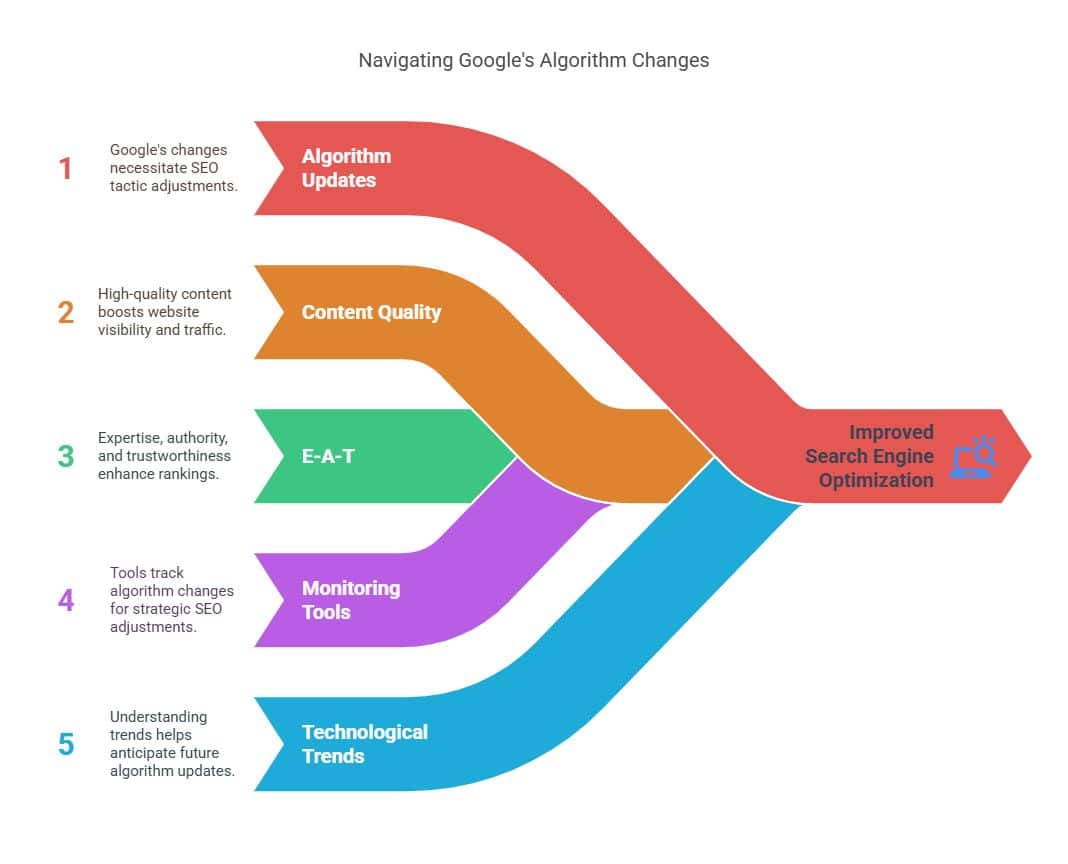
- When Google updates its algorithms businesses must adjust their search engine optimization tactics.
- Core updates prioritize content quality, relevance, and user experience, impacting website visibility and traffic.
- Expertise, authority, and trustworthiness (E-A-T) are crucial elements for achieving higher rankings post-update.
- Tools that monitor assist in following algorithm modifications and directing strategic adjustments for search engine optimization.
- Anticipating future updates requires understanding technological trends and evolving user behavior.
Understanding Google Algorithms
Understanding Google algorithms is essential for anyone involved in search engine optimization (SEO). These algorithms are complex systems that Google uses to retrieve data from its search index and instantly deliver the best possible results for a query. With frequent google algorithm updates, staying informed becomes crucial for SEO experts aiming to maintain or improve a website’s search ranking.
Google’s algorithm updates significantly influence the search engine results page. These updates modify website visibility and the traffic websites receive. Among these updates, core algorithm updates are particularly significant. They involve comprehensive changes to the way Google’s search algorithms evaluate and rank websites. These updates are designed to improve the relevance and quality of search results, ensuring users receive more accurate information swiftly.
For SEO experts, understanding the nuances of a core algorithm update is vital. It allows them to adapt strategies and optimize content so that a website can continue to thrive in the fluctuating landscape of search rankings. SEO professionals must analyze changes in search engine results pages to identify patterns or shifts in ranking criteria, enabling them to adjust their approach accordingly.
Becoming proficient with Google algorithms demands a combination of technical expertise and strategic vision. It is a dynamic process where SEO experts must continuously learn and adapt, ensuring that their strategies align with Google’s evolving algorithms.
The History of Algorithm Updates
Since its inception, Google‘s approach to refining search results has evolved through a series of algorithm updates, each shaping the landscape of search engine optimization. The history of Google algorithm updates is marked by significant milestones that have defined how content is ranked and presented to users. Early updates, such as the 2003 Florida update, disrupted traditional SEO practices by targeting keyword-stuffing techniques, setting a precedent for more sophisticated changes to follow.
As the digital environment matured, Google algorithm updates became more frequent and impactful. The 2011 Panda update was a watershed moment, targeting low-quality content and emphasizing quality over quantity. This was followed by the 2012 Penguin update, which penalized websites using manipulative link schemes. These updates collectively pushed the SEO community to adopt more ethical and user-focused strategies.
The introduction of core updates further transformed the Google search algorithm landscape. Core updates, which occur several times a year, aim to enhance overall search quality by refining how Google understands and ranks content. These updates, although not targeting specific issues, often result in noticeable shifts in search rankings, prompting SEO professionals to continuously adapt their strategies.
In recent years, Google search algorithm updates have increasingly leveraged artificial intelligence and machine learning, notably with the 2019 BERT update. This evolution underscores Google’s commitment to improving search accuracy and relevance.
The history of Google algorithm updates illustrates a trajectory towards prioritizing user experience and content authenticity, challenging the SEO community to innovate and align with these evolving standards.
Impact on Search Rankings

The evolution of Google’s algorithm updates has inevitably led to profound effects on search rankings, compelling SEO practitioners to continuously refine their approaches. Each core update released by Google is designed to improve the search engine’s ability to deliver relevant and high-quality content to users. These updates often lead to significant ranking changes, which can cause fluctuations in a website’s visibility and traffic. Understanding the impact of these updates is crucial for SEO professionals aiming to maintain or enhance their search rankings.
Core updates are particularly influential, as they entail comprehensive modifications to Google’s search algorithm. These updates can affect various aspects of a website’s performance, such as relevance, authority, and user experience. Consequently, websites that once held high positions in search rankings may experience drops if they fail to align with the new criteria established by the algorithm.
SEO strategies must adapt to these changes by focusing on content quality, relevance, and technical optimization.
The dynamic nature of Google algorithm updates demands that SEO professionals stay informed and responsive. By analyzing ranking changes following a core update, SEO experts can identify patterns and adjust their tactics accordingly. This might involve revising content strategies, improving site speed, or enhancing mobile compatibility.
Ultimately, the ability to swiftly adapt to these updates determines a site’s success in maintaining favorable search rankings.
Key Updates to Know

Navigating the intricate landscape of Google’s search algorithms requires knowledge of key updates that have shaped SEO practices. Over the years, google algorithm updates have evolved, significantly impacting how websites are ranked in search results. Among these, understanding the core algorithm updates is crucial for anyone in the SEO world. These updates are designed to improve the overall relevance and quality of search results, compelling SEO professionals to continuously adapt their strategies.
One of the most notable updates is the Google Panda update, introduced in 2011. This update targeted low-quality content, ensuring that websites with high-quality, original content were rewarded with higher search engine rankings.
Following closely was the Penguin update in 2012, which focused on penalizing websites using manipulative link-building tactics. These updates reinforced the necessity of ethical SEO practices, emphasizing content quality and authentic link profiles.
The Hummingbird update in 2013 marked a shift towards understanding the context and intent behind search queries, rather than just matching keywords. This change encouraged the development of content that addresses user needs comprehensively.
More recently, the BERT update in 2019 further advanced the search engine’s ability to understand natural language, enhancing the accuracy of search results.
Another significant element is the google core update, which occurs several times a year. These updates refine the core algorithm and can lead to fluctuations in search rankings.
Staying informed about these updates is imperative for maintaining or improving a site’s visibility in search results. As the SEO world evolves, understanding and adapting to these key updates remains essential.
Core Update Effects

Amidst the ever-evolving digital landscape, Google’s core updates play a pivotal role in shaping the dynamics of search engine optimization. These updates, often rolled out multiple times a year, are designed to refine the google search algorithm, ensuring that users receive the most relevant and authoritative content in their search results.
The core update effects are profound, as they can significantly alter the visibility and ranking of websites, impacting their online presence and traffic.
The essence of a google core algorithm update lies in its ability to assess the quality and relevance of web content more efficiently. Unlike more targeted algorithm updates, core updates encompass a broad spectrum of factors that influence the ranking algorithm.
They are not penalties, but rather adjustments that reward high-quality content and demote sites that may have previously benefited from outdated optimization tactics.
One of the most noticeable core update effects is the fluctuation in search engine rankings. Websites that adhere to best practices in content quality, user experience, and technical SEO often see improvements in their positions.
Conversely, sites that lack these elements may experience a decline. This shift underscores the importance of regularly auditing and enhancing website content to align with the evolving standards of the google search algorithm.
How Updates Affect Content

Google’s core updates, while reshaping search engine rankings, also have a profound impact on web content itself. In the rapidly evolving landscape of SEO, the core update of 2023 underscores the necessity for content creators to adapt to Google’s ever-changing algorithms to maintain visibility and relevance. Understanding the nuances of these google algorithm updates is crucial for anyone looking to optimize their content effectively.
The core update of 2023 particularly emphasizes content quality, relevance, and user experience. Google search ranking criteria now prioritize content that demonstrates expertise, authority, and trustworthiness (E-A-T). This means that content must not only be informative but also credible and engaging. Web pages that fail to meet these standards may see a decline in their google search ranking, highlighting the intrinsic link between quality content and SEO performance.
Moreover, the core update of 2023 places significant importance on user intent, further compelling content creators to focus on understanding and addressing the needs of their audience. This shift requires a more strategic approach to content creation, where understanding the searcher’s intent becomes paramount. The ability to produce content that aligns with user expectations is vital for maintaining or improving search rankings.
Additionally, this update has encouraged a deeper integration of multimedia elements. Incorporating diverse content types such as videos, infographics, and interactive media can enhance user engagement, thereby positively influencing search rankings.
As Google continues to refine its algorithms, content creators must remain agile, ready to adjust and innovate, ensuring their content not only meets but exceeds the evolving standards of google algorithm updates.
Adjusting SEO Strategies

In the digital realm, the adaptability of SEO strategies is paramount for success in the wake of frequent Google algorithm updates. As Google announced numerous changes to its core algorithm, businesses must realign their SEO strategies to maintain or enhance their visibility in search results. Understanding the impact of these updates on search queries is crucial for effective adaptation.
One key aspect of adjusting SEO strategies is staying informed about the specific nature of the algorithm update. When Google announced changes, it often provided insights into what aspects of websites might be affected—whether it’s content quality, site speed, or mobile-friendliness. This information serves as a guide to refocus efforts on the most pertinent areas.
To effectively adjust SEO strategies, consider the following:
- Content Quality: Emphasize creating valuable, relevant, and original content that aligns with user intent. Google core updates often prioritize websites that deliver genuine value to users.
- Technical SEO: Ensure your website is technically sound. This includes optimizing site speed, mobile responsiveness, and ensuring proper indexing. Technical improvements can significantly impact how search queries result in traffic.
- User Experience: Focus on enhancing the user experience by simplifying navigation, reducing load times, and ensuring a seamless mobile experience. Google’s algorithm updates frequently reward websites that offer superior user experiences.
Tools for Monitoring Changes

Monitoring the effects of Google’s algorithm updates is vital for maintaining effective SEO strategies. As search engines continually evolve, staying informed about these changes is crucial. Various tools for monitoring changes provide invaluable insights, helping businesses understand how their search rankings are impacted by Google algorithm updates. Such tools can reveal trends and fluctuations in website performance, allowing for timely adjustments.
Search Engine Land, a trusted source in the SEO world, frequently discusses these updates, offering insights into their implications. Utilizing these tools not only aids in understanding the nuances of each update but also in identifying which specific areas of a website might be affected. For instance, when an update targeted at mobile usability is released, a tool might highlight areas needing improvement, such as page speed or mobile responsiveness.
Here’s a table illustrating some popular tools and their benefits:
| Tool Name | Key Benefit |
| SEMrush | Comprehensive keyword tracking |
| Moz | In-depth site audits and analytics |
| Ahrefs | Backlink analysis and rank tracking |
Each tool brings unique capabilities to the table, and understanding which tool aligns best with your business needs is essential. Previous updates have shown that adaptability is key; tools for monitoring changes enable businesses to maintain agility amidst evolving algorithms. By leveraging the insights from these tools, businesses can ensure that their SEO strategies remain effective and aligned with current search trends. This proactive approach not only safeguards rankings but also enhances overall site performance, ensuring continued visibility in the competitive digital landscape.
Common Misconceptions

Many misunderstandings persist around the impact and nature of Google algorithm updates on SEO practices. These misconceptions can lead to misguided strategies and ineffective optimization efforts.
One widespread belief is that each Google update results in drastic shifts in search rankings across the board. However, not every algorithm change has an immediate, sweeping effect. Often, updates target specific issues or refine existing systems to improve the quality of organic search results.
Another common misconception is that Google’s search algorithm prioritizes new content over older, established pages. While freshness can be a ranking factor for certain queries, quality and relevance remain paramount. Google’s algorithms are designed to assess content based on a multitude of factors, ensuring that users receive the most pertinent information, regardless of its publication date.
A third misunderstanding involves the idea that algorithm changes directly penalize websites. In reality, Google updates are generally aimed at enhancing the user experience rather than punishing sites. Negative impacts on rankings often arise from a failure to meet updated criteria for quality content and user engagement, rather than an intentional penalty.
To further clarify these common misconceptions, consider the following points:
- Not all updates are major: Many algorithm changes are minor and go unnoticed by most users, focusing on incremental improvements.
- Quality trumps recency: Google’s priority is serving relevant, authoritative content, regardless of when it was published.
- Adjustments, not penalties: Updates are designed to reward high-quality sites, not to penalize others without cause.
Understanding these nuances is crucial for developing effective SEO strategies in response to Google updates.
Future Update Predictions

Anticipating future Google algorithm updates requires a blend of insight, analysis, and understanding of current technological trends. As we approach 2024, the landscape of search engine optimization (SEO) is likely to evolve, driven by Google’s commitment to refining user experience and combating misinformation.
Looking ahead, several potential changes could be anticipated in the realm of Google algorithm updates.
First, enhanced content quality measures are expected, likely building on the recent spam update initiatives. Google has consistently prioritized content that offers genuine value to users, and future updates may further refine the ability to identify and downrank low-quality, spammy websites.
SEO professionals should focus on creating authoritative and engaging content that aligns with the anticipated changes in Google’s evaluation criteria.
Moreover, with advancements in artificial intelligence and machine learning, the integration of these technologies into Google’s algorithms is poised to deepen. Search Central has hinted at improvements in understanding context and semantics, suggesting future updates may enhance Google’s ability to interpret search intent with greater accuracy.
This shift could significantly impact keyword strategies and necessitate a more nuanced approach to SEO.
Final Thoughts
Google’s algorithm updates play a critical role in shaping SEO strategies and website visibility. To stay ahead in the evolving digital landscape, it’s essential to understand these updates, adapt strategies accordingly, and prioritize content quality, user experience, and technical optimization. Leveraging tools to monitor changes and focusing on building expertise, authority, and trustworthiness (E-A-T) will help maintain rankings and drive sustained success.
Want expert guidance on navigating Google’s algorithm updates and enhancing your website’s SEO? Connect with Syville Gacutan, an SEO Specialist in the Philippines, who can help you develop adaptive strategies, maintain search visibility, and achieve sustainable growth. Reach out now for personalized SEO solutions!